


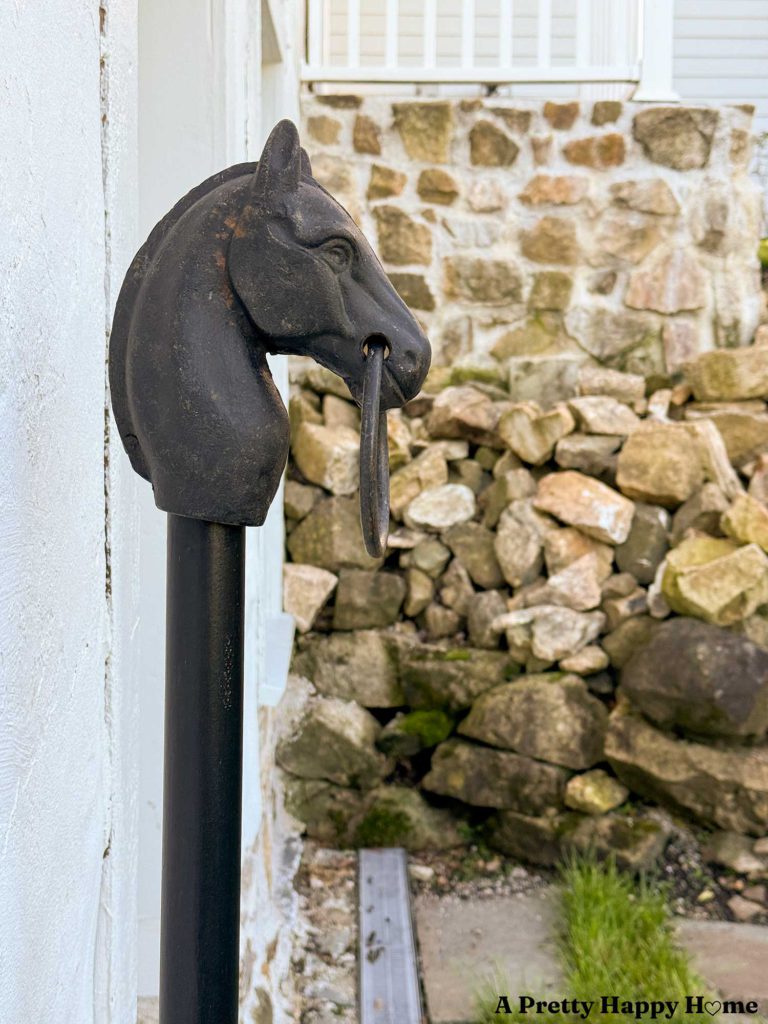
The only thing related to transportation that has not changed since our home was built in the 1780s is probably a kid asking, “Are we there yet?” Everything else, of course, from how we get places to where we park, has. A 1780s “parking spot” would have been a hitching post to tie up a horse. The hitching posts and the horses are long gone from here, but we decided to pay homage to this home’s original parking spot and install an antique cast-iron hitching post next to our Carriage House.
Specifically, we chose an antique hitching post with a horse head.
These were popular in the 1800s, and I love horse-related art, so it seemed like an all-around win. If you want to know how much I paid, I’ll put a note at the end of the blog post.
Do I know if this style of hitching post was ever used at this house? Of course not. If only there were a blog for me to read to know for sure.
While it isn’t possible for me to know specifics about my house, it is possible to know more about these original parking spots.
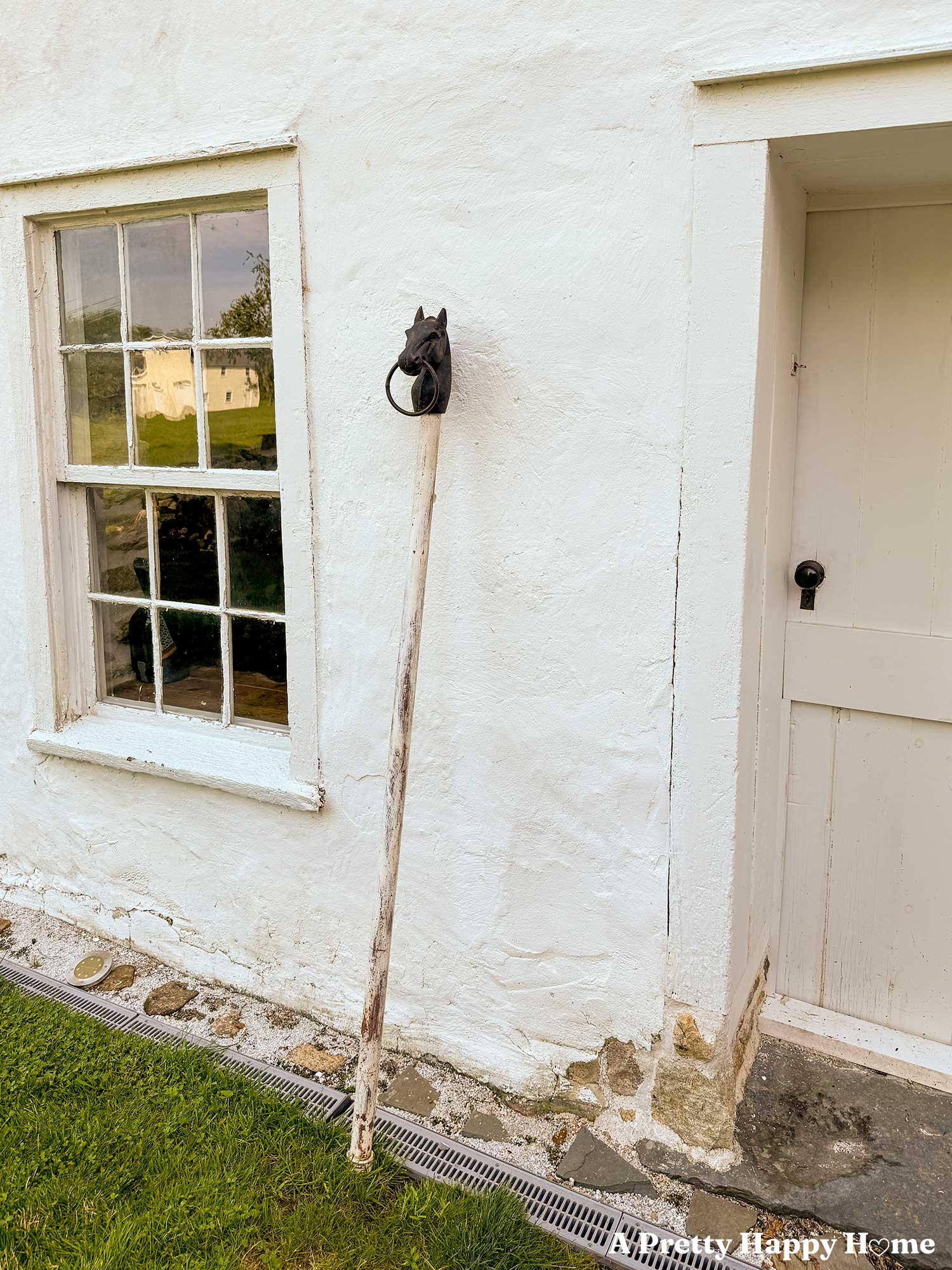

Saddle up for some hitching post history.
To be accurate for the metallurgy nerds in the crowd (nerd is always a compliment here), when our home was built in the late 18th century, the hitching posts or hitching rails would likely have been simpler and made from logs. Some hitching posts from the era could also have been made with stone blocks and iron rings, or simply an iron ring attached to the side of a building.
On a property like ours that had a house, a carriage house, and a barn, the homeowner likely had multiple places to tie a horse or horses.
It wasn’t until the mid 1800s that cast-iron hitching posts and the finials for hitching posts became popular in the U.S. This is partly due to industry advancements that led to hitching posts and finials being produced at scale and partly because more foundries existed in the U.S. by the mid-1800s.
The horse head version that we installed is fairly simple, but there were others produced that were much more ornate and weren’t horse-themed.
Please note that a hitching post could have come as one unit (post, top, and ring), or it could have just been the finial (post topper with the ring and no post). I know what I bought is a finial or post topper for a hitching post, but for the purpose of a non-technical blog, I’m using the term hitching post for both.
How we chose how high to install the hitching post. There are rules!
Equine science has changed greatly since the mid 1800s. Human science, too, thank goodness!
In the 1800s, hitching posts and rails were installed about 3.5 feet above ground, which was a convenient height and didn’t visually block a town’s streetscape. In the present time of 2026, the recommendation is to install a hitching post between 5.5 and 7 feet above ground.
A higher hitching post prevents the horse from getting tangled in a low lead rope, and should the horse panic and pull backward, being tied higher lessens the chance of them hurting their neck or poll.
It should be noted that rider behavior and equipment have changed greatly since the 1800s, which also contributes to the change in equine science. A rider in the 1800s would loosely loop leather reins connected to a bridle through the ring. The horses weren’t tied tightly, and the reins could release.
If a rider is tying up a horse in this modern era, they are likely tying the horse to the hitching post or rail with a nylon lead rope that’s attached to a halter. Different tack and materials make this a different proposition altogether.
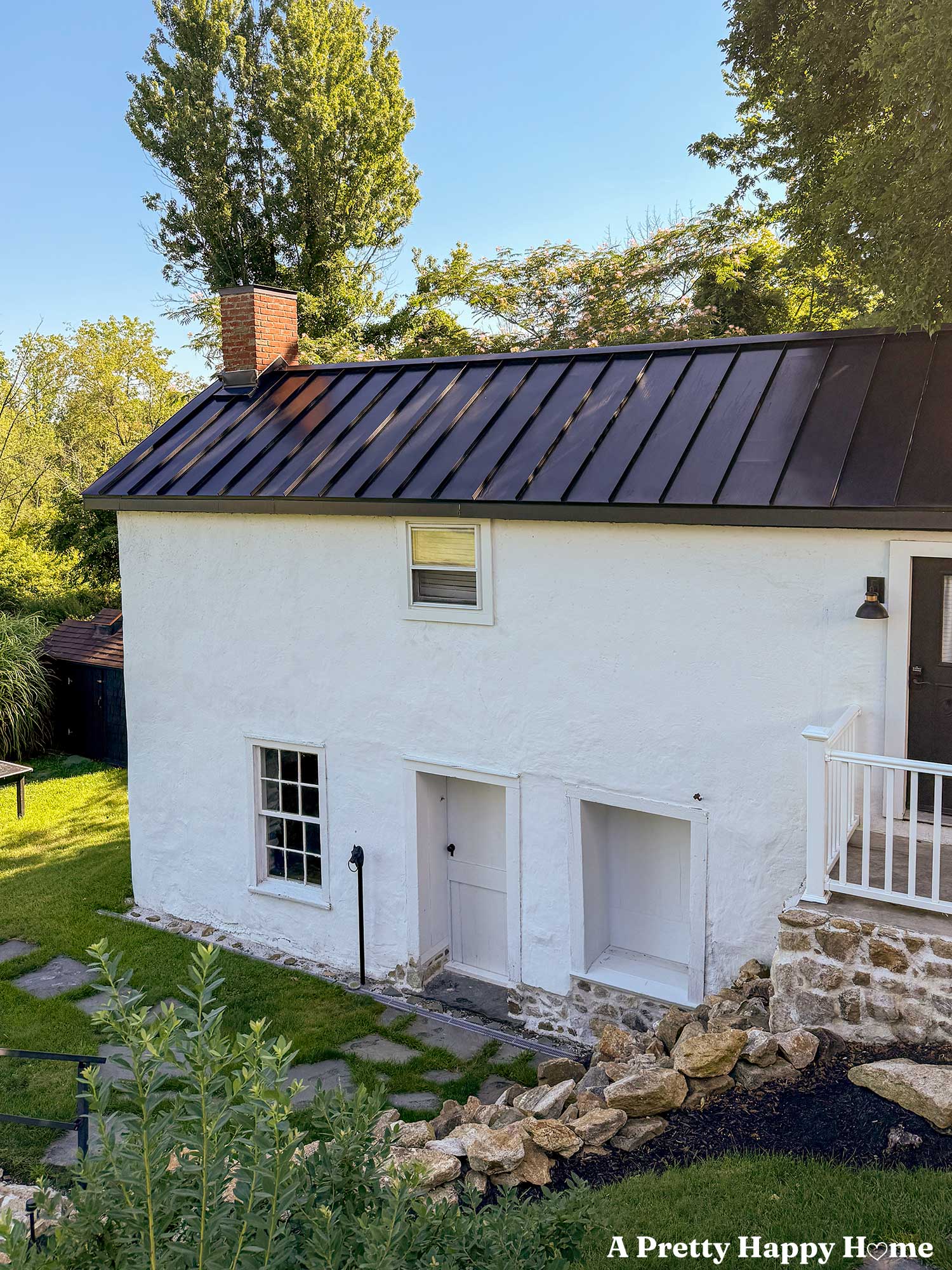
Since we don’t plan on getting horses or being visited by anyone traveling on horseback, we installed our antique hitching post at roughly the level preferred in the 1800s.
Only time will tell if that was short-sighted, but since we’re living in an era of self-driving cars, I think we’ll be okay.
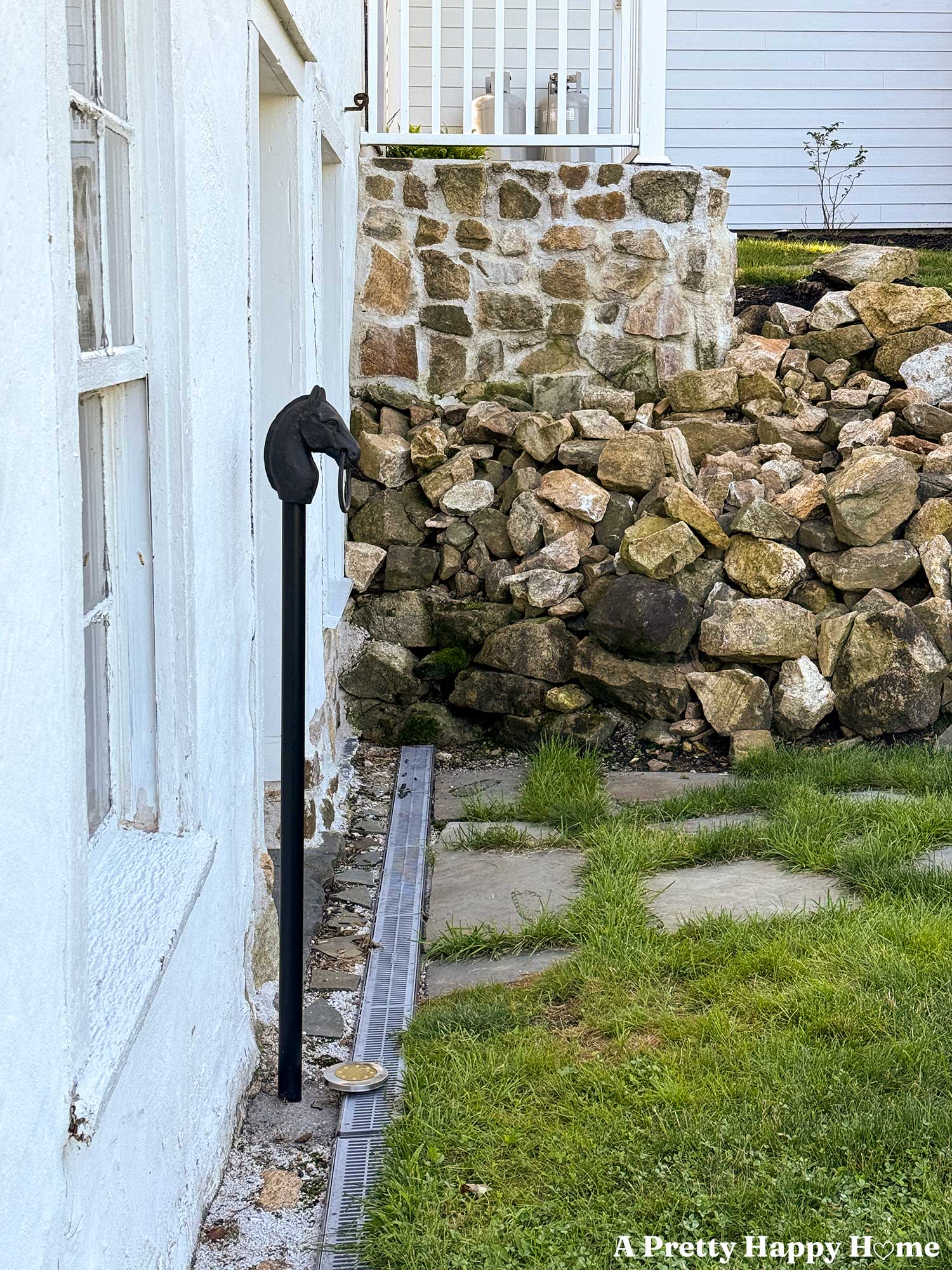
I feel obligated to tell you that we installed our hitching post close to the building just to make mowing the lawn easier. I didn’t need one more obstacle to mow or weed whack around, you know?
I also feel obligated to tell you that the hitching post is pretty plumb and level. We spent a lot of time on that. But! The building is not. It zigs and zags. It weaves and bobs. It curves in and out. So, no matter how I correct the leveling of the photo, something is always going to look off. Pinkie swear.
How do we know if this cast-iron horse head hitching post is antique?
Oh, I’ve been researching it! From what I’ve learned so far, I’m fairly certain this hitching post is an antique and not a modern reproduction.
First, the one I bought doesn’t have threads. Reproduction horse head finials are made to thread onto a 2-inch pipe, which makes installation a breeze.
Second, if you look closely at the picture below, there is a pin on the side of the horse’s head that initially held the two sides of the cast together before the seam was secured.
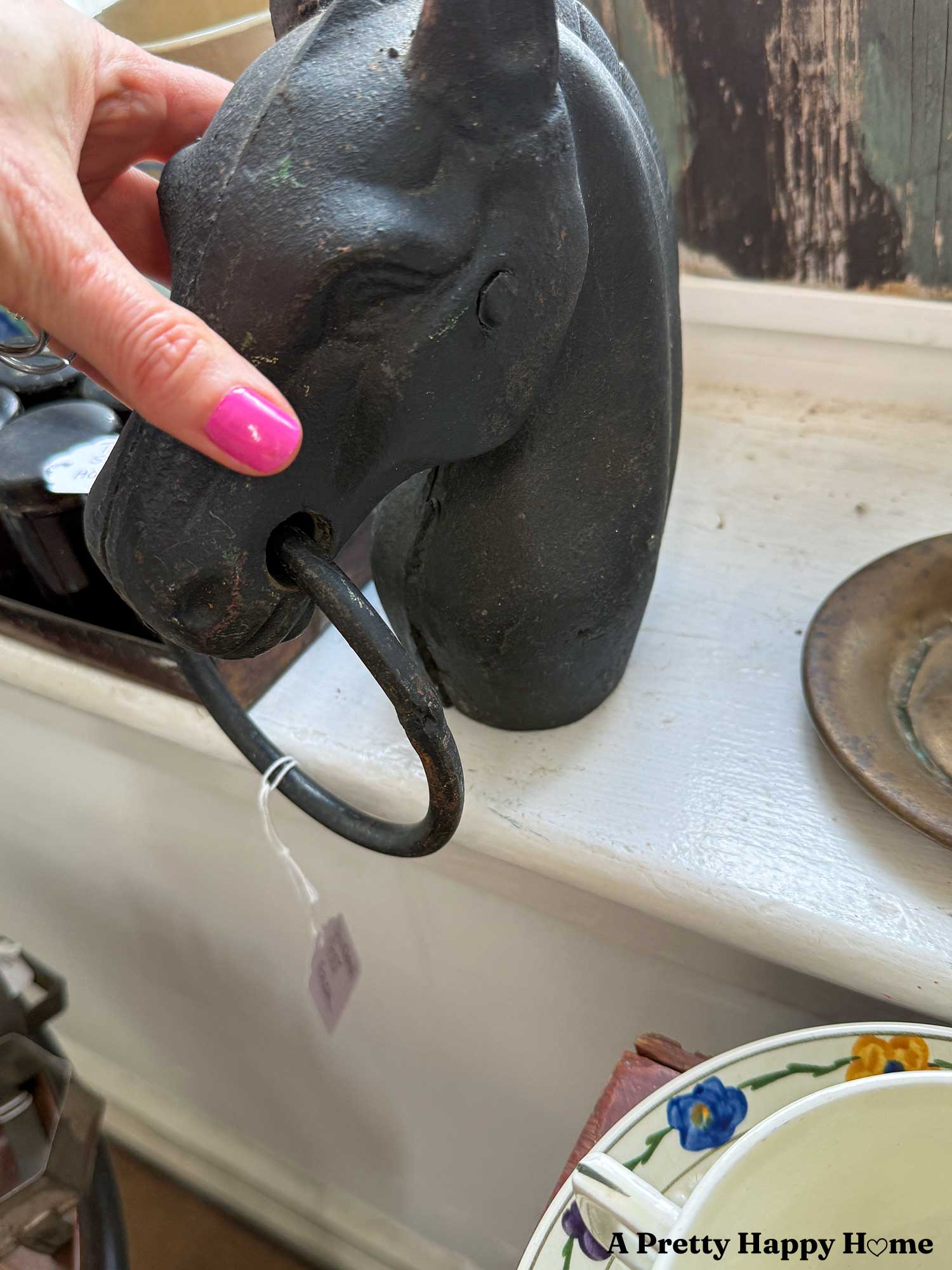
Third, speaking of the seam on this finial, you can see it in the photo below. Notice how the opening for the post is a bit wonky. It’s not a perfect circle, which speaks to the idea that the hitching post was used and, over time, the stress from being pulled on has made the opening a little misshapen. The variation in thickness of the cast iron around the circle is likely due to unevenness when the liquid metal was poured into the molds.
Last, it does have some rust and patina from being out in the elements. That, in and of itself, doesn’t mean a whole lot, but it is another clue that it didn’t come out of a warehouse yesterday.
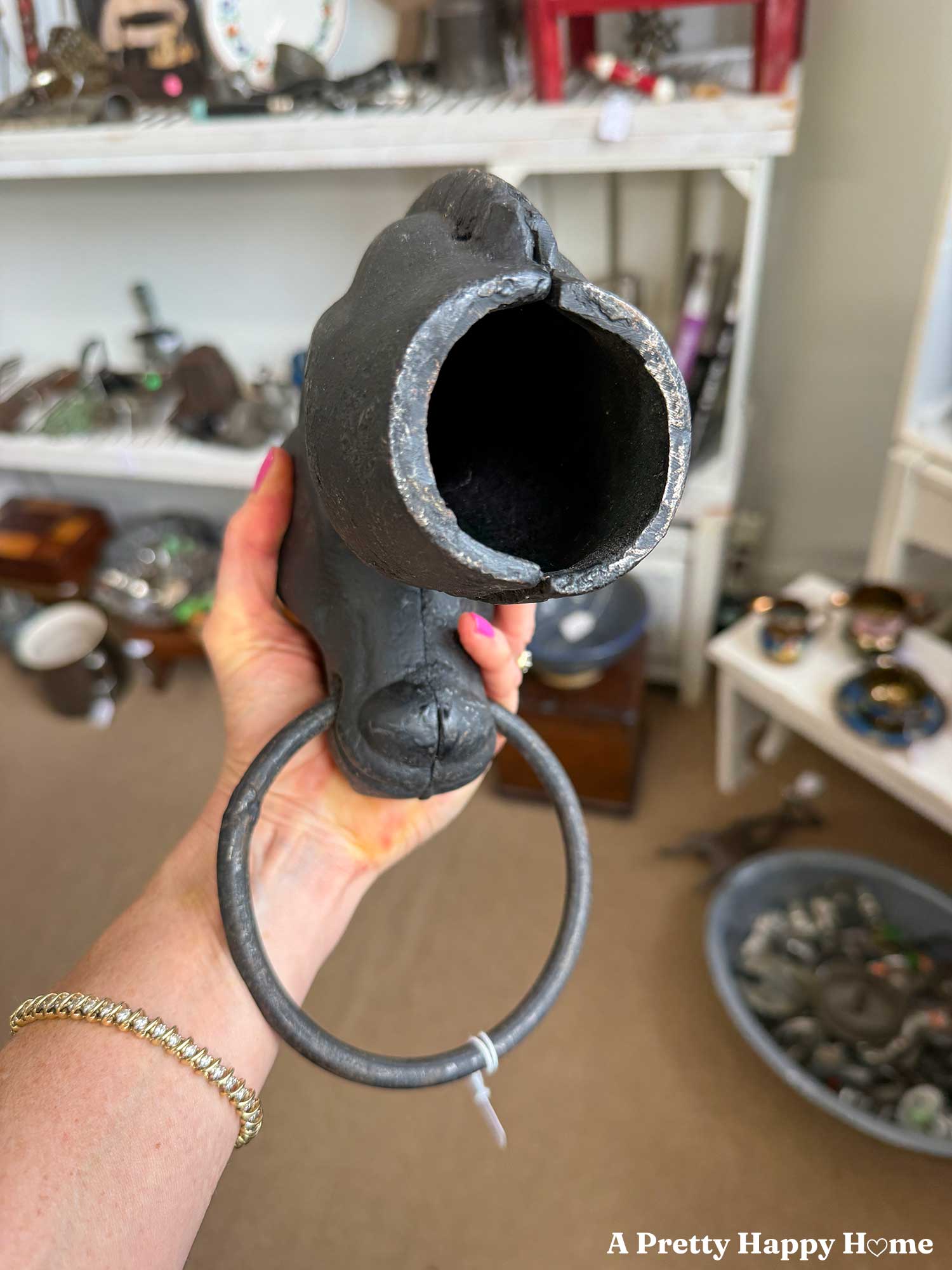
If I’m correct with the assessment of these clues, this horse head hitching post was probably made between 1880 and 1910, which puts it firmly in the antique category of objects over 100 years old.
Imagine our house being 100 years old in the 1880s and getting a “modern” hitching post. If I were that homeowner, I would have felt so fancy.
One thing I love about old houses is that they are living buildings that evolve to meet the needs of the current time and occupants. Reinstalling a hitching post seemed like a fitting nod to this home’s past that can happily coexist with the hybrid vehicle parked in our driveway.
Well, this was probably more than you ever wanted to know about hitching posts! Let me know if you ever work this topic into a conversation. You can comment here on this blog post, email me here, or reach out via direct message on Instagram or Facebook. Comments are like happy mail from a friend. They totally make my day!
To learn more about hitching posts and ironworks, check out these resources:
Decorative Ironwork by Margarete Baur-Heinhold
Cast-Iron Architecture in America by Carol Gayle and Margot Gayle
J.L. Mott Ironworks catalog via Internet Archive
To purchase a reproduction horse head hitching post, try this one.
The antique hitching post I purchased was listed for $70, but sold to me for $50. I don’t know if that’s a good deal, but it was less than the reproduction one! The deal ended up even better for me because my dad ended up paying for it. Thankfully, I had also been hoarding a post that fit the horse head perfectly.
I did have to buy matte black paint to paint the post, though. So, there’s that.
Thank you for moseying on over to my blog today. If you’d like another blog post to read before you ride off to your next destination, try one of these:
7 Lucky Horseshoe Decor Ideas for Your Home
Stained Glass Horse Head Art in a Laundry Room
Happy Thrifting: Elephant’s Trunk Flea Market (Scored a Carved Horse Head)
*affiliate links in this blog post*