Where to Buy Natural Hydraulic Lime (NHL) in the U.S. to Mix Lime Mortar
U.S. Natural Hydraulic Lime (NHL) Suppliers
| Supplier & Brand | Region / Hub | Best For… |
|---|---|---|
| Atlas Preservation Brand: Otterbein | Northeast / National Berlin, CT | Best for DIYers and small projects. Easy online ordering for single bags. |
| Henry Frerk Sons Brand: St. Astier | Upper Midwest Chicago, IL | High-volume stock. Excellent for regional pickup to avoid heavy shipping fees. |
| Pro Mason Supply Brand: American Lime | Deep Midwest Olathe, KS | Fills the “shipping desert” for Kansas, Missouri, and Nebraska. Great technical support. |
| LimeWorks.us Brand: St. Astier / Ecologic | Mid-Atlantic Quakertown, PA | Extensive documentation and pre-mixed “Ecologic” mortars for easy matching. |
| Sage Restoration Brand: St. Astier | Canada / Northern US Ontario, CAN | Reliable cross-border shipping and the primary choice for Canadian projects. |
| U.S. Heritage Group Brand: Custom Heritage | Technical / Midwest Chicago, IL | Use them for laboratory mortar analysis and matching for historic foundations. |
U.S. Natural Hydraulic Lime (NHL) Lab Services
| Supplier / Lab | Location | Lab & Analysis Services | Best For… |
|---|---|---|---|
| LimeWorks.us | PA | Full spectrum lab. Free visual matching, custom “biscuits,” and acid digestion analysis. | DIYers wanting a visual color match before buying materials. |
| U.S. Heritage Group | IL | Scientific analysis ASTM C1324 microscopic petrography and formal mortar reports. | Formal restoration projects requiring scientific proof of mix ratios. |
| Henry Frerk Sons | IL | Practical matching – In-house visual and ratio matching for Chicago regional pickups. | Midwest owners who want to drop off a sample and pick up bags the same day. |
| Lancaster Lime Works | PA | Mason-led lab with detailed acid digestion tests to determine original sand/lime ratios. | Masons looking for a “prescription” of exactly how to mix their sand. |
| Atlas Preservation | CT | Retail only. No formal lab, but industry-leading support for Otterbein products. | N/A |
*Note: Lab turnaround times typically range from 2 to 6 weeks. Always keep a backup control sample at home.

Different Types of Lime for Mortar: Hydrated vs. Natural Hydraulic Lime (NHL)
When you start looking into lime mortar, you’ll quickly discover there are different types of lime. The two main categories you’ll encounter for mortar are:
Hydrated Lime (or Non-Hydraulic Lime): This type of lime hardens very slowly by reacting with carbon dioxide in the air. This is called carbonization. It’s very breathable and flexible, which is great for historic buildings. However, it requires specific conditions to cure properly – it needs to be kept damp for an extended period and protected from frost. It’s often used for internal plasterwork or in sheltered locations where it’s not exposed to harsh elements.
If you want to know why Type S lime, which is hydrated, isn’t typically recommended for foundation repointing, check out my Lime Mortar FAQs.
Natural Hydraulic Lime (NHL): NHL is made from limestone containing natural impurities (like clay) that give it “hydraulic” properties. This means it can set with air and water, similar to cement, but it still retains the breathability and flexibility that make lime mortar so desirable. NHLs are graded by their compressive strength (e.g., NHL 2, NHL 3.5, NHL 5). The higher the number, the stronger and faster-setting the lime. Most residential foundations will use NHL 3.5, but ALWAYS double-check with your supplier because the type of stone and extreme conditions can affect this.
Why We Chose Natural Hydraulic Lime (NHL) for Our Stone Foundation
I like to think of natural hydraulic lime (NHL) as the modern standardization of ancient lime. It uses the same ‘breathable’ chemistry that has worked for thousands of years, but it’s engineered to be predictable and reliable for real-world projects today, especially for DIYers. NHL offers:
Durability and Weather Resistance: Stone foundations are constantly exposed to moisture, frost, and general weathering. NHL’s ability to set with water gives it a much faster initial set and greater resistance to these environmental factors compared to hydrated lime. This means your repointing work will stand up better to the test of time. We’re aiming for 100 plus years.
Faster Curing: While still breathable, NHL cures more quickly than hydrated lime, reducing the time your fresh mortar is vulnerable to wash-out or frost damage. This is a practical advantage, especially for exterior work.
Good Balance of Flexibility and Strength: NHL 3.5 is usually best for residential work. It’s strong but not too hard for your foundation while remaining breathable.
Self-Healing: One of the coolest properties of lime mortar is autogenous healing. If micro-cracks form due to building settlement, the lime can actually dissolve when the foundation takes on moisture and re-deposit into the crack when the moisture is released or evaporates, effectively sealing itself. A concrete foundation is not going to heal itself, unfortunately.
Tools Needed For Repointing a Stone Foundation
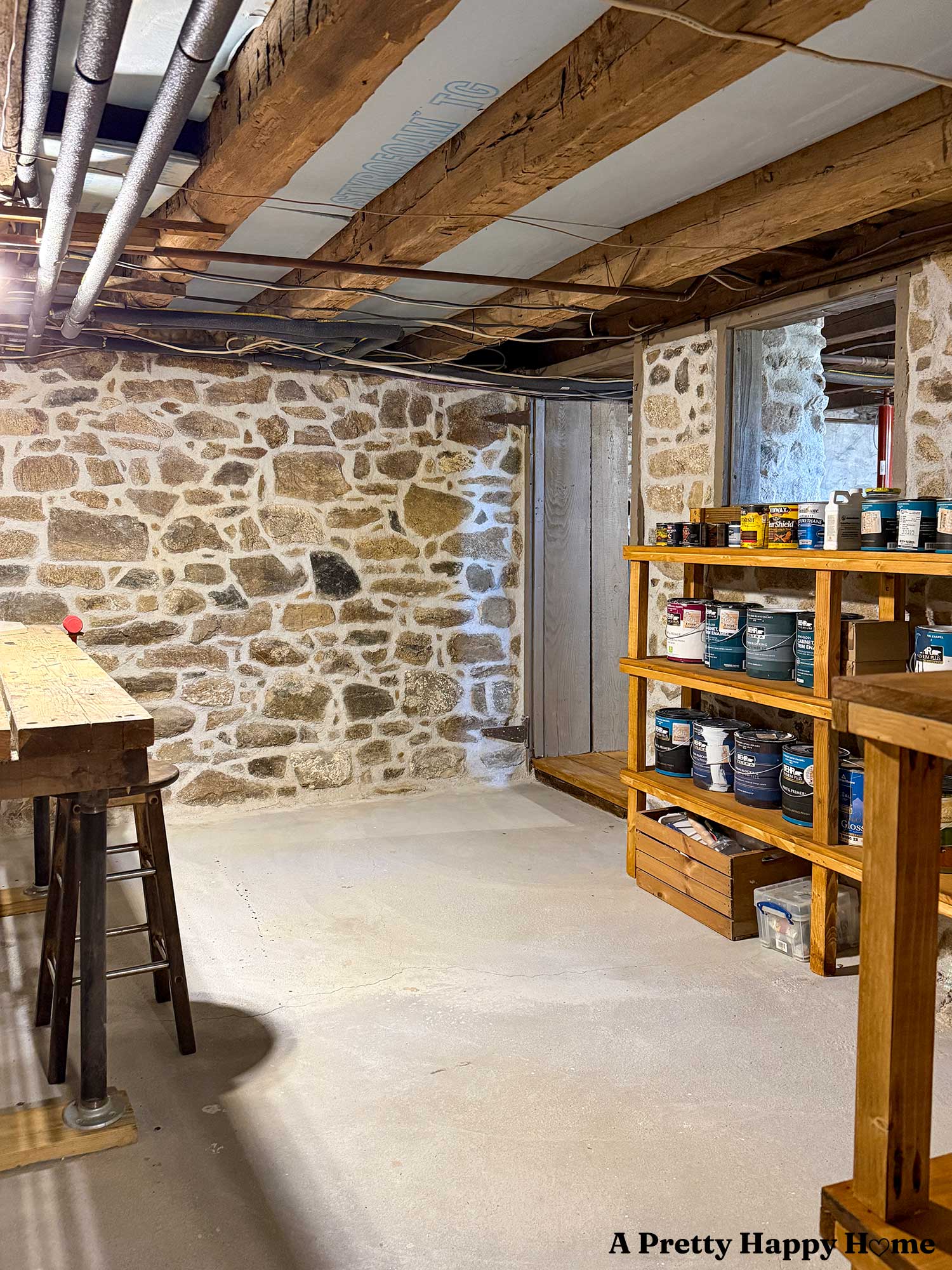
There aren’t that many tools needed for repointing. Talk about a work perk! The tools we use are all listed on our Amazon Storefront for your convenience, not because it’s necessarily the best place to get them. Sometimes it is, sometimes it isn’t. You know how it goes. Always check prices!
mason’s hawk (Comes in different sizes.)
mortar tub
trowel
slicker like this or this set (They come in different sizes.)
utility patcher (This is easier for me to use than the slicker for the fieldstone.)
(not pictured) churn brush
masonry hammer
chisels
pneumatic chisel (We use this hammer drill with a chisel bit.)
shop vac
respirator
safety glasses
ear protection
gloves (comes in different sizes)
tarp and/or burlap to protect/slow down the drying
Lime mortar is caustic, so definitely wear gloves.
For questions about how to mix the lime mortar, how to apply it, how to clean up, etc., please check out this Lime Mortar FAQ article. You can also visit our Instagram page for videos on the topic.
Are you considering repointing your home’s historic stone foundation with lime mortar? Let me know how it goes!
You can comment here on this blog post, email me here, or reach out via direct message on Instagram or Facebook.
Happy DIYing.
Thank you for spending part of your day here. If you’d like another blog post to read, try one of these gems!
Stone Carriage House Gym: Part 5, Adding a Window to a Stone Wall
Basement Workshop Repointing: Part 2, Concrete Problem
The Mistake We Made When Adding Hardscaping Around An Old Pool
*affiliate links in this blog post*


You May Also Like

DIY Charging Bench for Electronic Devices
Basement Workshop Stone Repointing: Part 1, Why Now
